
For a long time, APIs were treated as implementation assets. A business team would close a partnership, a product team would define the use case, and then engineering would be asked to “expose an API” to make it work. That model worked when integrations were limited, timelines were forgiving, and most platforms still controlled the entire customer journey themselves.
That is no longer the world in which digital platforms operate.
Today, growth rarely happens in one owned interface. It happens across partner apps, marketplaces, channel systems, internal products, and third-party workflows. In that environment, APIs are no longer a support layer sitting behind the business. They increasingly shape how the business expands.
That is why API-first designs are becoming the default for serious digital platforms. Not because it is a fashionable architecture language, but because it changes how fast a platform can scale, how easily it can integrate, and how effectively it can create repeatable distribution.
The real shift is not technical. It is commercial.
When people hear “API-first,” they often interpret it as an engineering choice. In reality, the bigger shift is commercial.
An API-first platform is built with the assumption that capabilities will need to be consumed in multiple ways – by internal teams, by channel partners, by fintechs, by enterprise customers, and sometimes by entirely new business models that do not exist on day one. That changes the design approach from the start.
Instead of building one product and then creating custom pipes around it, the platform begins by defining reusable capabilities. Identity verification, loan origination, consent capture, collections workflows, account opening, partner onboarding, alerts, analytics – these are no longer trapped inside one application flow. They become modular services that can be assembled, extended, and distributed.
That is where the idea of an API ecosystem becomes important.
An API ecosystem is not simply a set of published APIs with documentation. It is a broader operating model where multiple participants can build, integrate, and generate value on top of a common platform. The distinction matters. Many companies expose APIs. Far fewer create ecosystems around them.
And that difference is usually visible in the market.
Also Read: API Pricing in India: Time to Move Beyond Per-Call Thinking
APIs are now influencing distribution, not just integration
This is where I think many platform conversations still remain too narrow. APIs are often discussed in technical terms – reliability, response time, gateway policy, security, throttling. All of that matters. But from a GTM lens, the more important question is this: what kind of growth model do your APIs enable?
A strong API ecosystem changes distribution in three important ways.
First, it reduces dependence on one to one implementation effort. If every new partner requires heavy customization, long handholding, and special case logic, growth remains linear. The number of integrations rises, but the business does not actually become more scalable. API-first platforms break that pattern by making onboarding more standardized and easier to repeat.
Second, APIs allow platform reach to extend beyond owned channels. A capability does not need to live only in your interface anymore. It can be embedded where the demand already exists. That is a meaningful shift for businesses trying to grow through partnerships, ecosystems, or embedded models.
Third, APIs improve platform stickiness more structurally. When a partner or customer builds your services into their own workflow, your product stops being just another vendor feature. It becomes part of their operating flow. That makes the relationship deeper and more durable.
This is one of the clearest reasons API-first designs are becoming strategic. They do not just make software reusable. They make growth reusable.
Why digital platforms are moving in this direction
There are a few structural reasons this shift is accelerating.
Customer journeys are now fragmented by design. A user may discover a service in one interface, complete KYC in another, make payments through a third system, and continue servicing through yet another layer. Platforms cannot assume they will own the full journey. They have to participate in it. APIs make that possible.
Partnership cycles are also under pressure. Businesses no longer want multi-quarter integration programs for every collaboration. They want faster launch timelines, lower dependency on core teams, and more confidence that future changes will not break everything downstream. API-led models support that expectation much better than bespoke integration-led models.
Then there is monetisation. Increasingly, APIs are not just enabling revenue; they are part of the revenue model itself. Whether through usage-led pricing, partner access, embedded services, platform enablement, or marketplace participation, APIs are becoming commercial assets. Once that happens, the quality of API design begins to affect business outcomes directly.
This is exactly why the term API ecosystem matters more than just “APIs.” A single API can solve a task. An ecosystem can scale a platform.
What GTM teams often understand earlier than product teams
One interesting pattern in platform businesses is that GTM teams often feel the limitations of poor API strategy before anyone else does.
Sales sees it when every enterprise conversation turns into a special integration request. Partnerships see it when onboarding timelines start killing momentum. Customer success sees it when each rollout becomes too dependent on manual coordination. Marketing sees it when the product story is hard to position consistently because every implementation looks different.
From the outside, these may look like execution issues. But quite often, they are symptoms of weak platform design.
When APIs are designed well, GTM becomes easier. Value propositions are clearer. Partner enablement improves. New use cases can be opened without rebuilding the core every time. Channels can adapt faster because they are consuming defined capabilities instead of negotiating custom development each time.
That is why I do not see APIs as back-end assets alone. In platform businesses, they define how efficiently the company can go to market.
Governance becomes more important as the ecosystem expands
The moment a platform begins to scale through APIs, governance stops being optional.
This is where many organisations overcorrect in one of two directions. Either they create no common standards and end up with fragmented APIs, inconsistent naming, weak versioning, and painful developer experience. Or they create such heavy controls that every new API becomes slow to launch and difficult to evolve. Neither model works for scale.
Good API Governance should not be understood as restriction. It should be understood as a growth discipline. Its purpose is to create enough consistency that teams can move faster without increasing risk each time they release.
In practice, that means governance should help answer questions like:
1) Are APIs designed in a way that other teams and partners can actually adopt easily?
2) Are security and compliance built into the operating model rather than patched in later?
3) Is there clarity on versioning, discoverability, ownership, and lifecycle management?
4) Can teams launch quickly without creating long-term design debt?
The strongest platforms are usually the ones that make good decisions easy to repeat. That is what API Governance should do. It should improve quality without slowing momentum.
What separates a true API ecosystem from a collection of APIs
This is where the conversation becomes more strategic.
A company does not build an API ecosystem simply by publishing endpoints. It builds one when the platform is intentionally designed for reuse, adoption, and extension. You can usually tell the difference quickly. A collection of APIs says: “Here is what our product can expose.”
An ecosystem says: “Here is how others can build, distribute, and create value with us.”That second mindset changes everything. It affects documentation, onboarding, sandbox quality, governance, packaging, pricing, partner engagement, and even internal alignment between product, sales, and engineering.
Most importantly, it changes how the platform is perceived in the market. Instead of being seen only as an application vendor, the business starts being seen as an enabler. That is a very different strategic position to occupy.
The Vahana Hub perspective
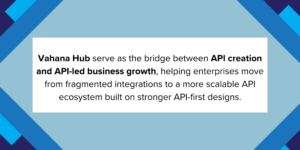
From a Vahana Hub perspective, the opportunity is much bigger than API management in the traditional sense. As digital platforms move toward ecosystem-led growth, they need a layer that makes APIs easier to discover, govern, distribute, and operationalize across teams and partners. That is where Vahana Hub becomes strategically relevant.
Final thought
The strongest digital platforms today are not necessarily the ones building the most features inside one interface. They are the ones creating capabilities that can travel across channels, partnerships, and use cases without losing control, consistency, or speed.
That is why API-first designs are becoming the standard.
Not because every company suddenly wants to sound more modern, but because platform growth increasingly depends on extensibility. And extensibility does not come from having APIs alone. It comes from building an API ecosystem that others can adopt with confidence.
In the coming years, the real winners will be the platforms that stop asking, “What APIs do we need to expose?” and start asking, “What kind of ecosystem are we making possible?”
About the Author: Saloni Gautam is Senior Manager – GTM at Decimal Technologies, working at the intersection of fintech innovation and enterprise architecture. Her work focuses on enabling banks to build resilient, API-driven digital platforms that support scalable customer journeys.